Production Traceability: Connecting Machines, Operators, and Software
Production traceability becomes valuable when machine data, quality checks, operator activity, and work-order progress can be connected in time to support better decisions.
- Related area
- IoT and hardware/software integration
- Decision context
- Industrial software
- Work orders, batches, lots, serial numbers, or production phases from the management system.
- Machine events such as start, stop, alarm, cycle count, temperature, pressure, speed, or status.
- Operator actions such as login, confirmation, manual checks, or declared downtime reason.
Production traceability is not only about storing data. It is about knowing what happened, when it happened, who was involved, which machine or station was used, and whether the result matches the expected quality standard.
When machine signals, operator actions, quality checks, and management software remain disconnected, the company can still produce. But it becomes harder to understand delays, isolate defects, prove compliance, or improve the process with reliable information.
When traceability starts to matter
Traceability becomes important when the cost of not knowing is higher than the cost of building the connection. This may happen because of quality claims, regulated processes, recurring rework, production delays, or the need to understand actual performance across shifts and lines.
The strongest signal is usually operational: people spend time reconstructing what happened after the fact. They compare machine logs, paper sheets, ERP data, emails, and memory. A traceability system should make that reconstruction unnecessary for the most important events.
Data that may need to be connected
- Work orders, batches, lots, serial numbers, or production phases from the management system.
- Machine events such as start, stop, alarm, cycle count, temperature, pressure, speed, or status.
- Operator actions such as login, confirmation, manual checks, or declared downtime reason.
- Quality controls, measurements, non-conformities, photos, and approval results.
- Timestamps that allow the team to rebuild the sequence of events reliably.
Hardware integration is only part of the problem
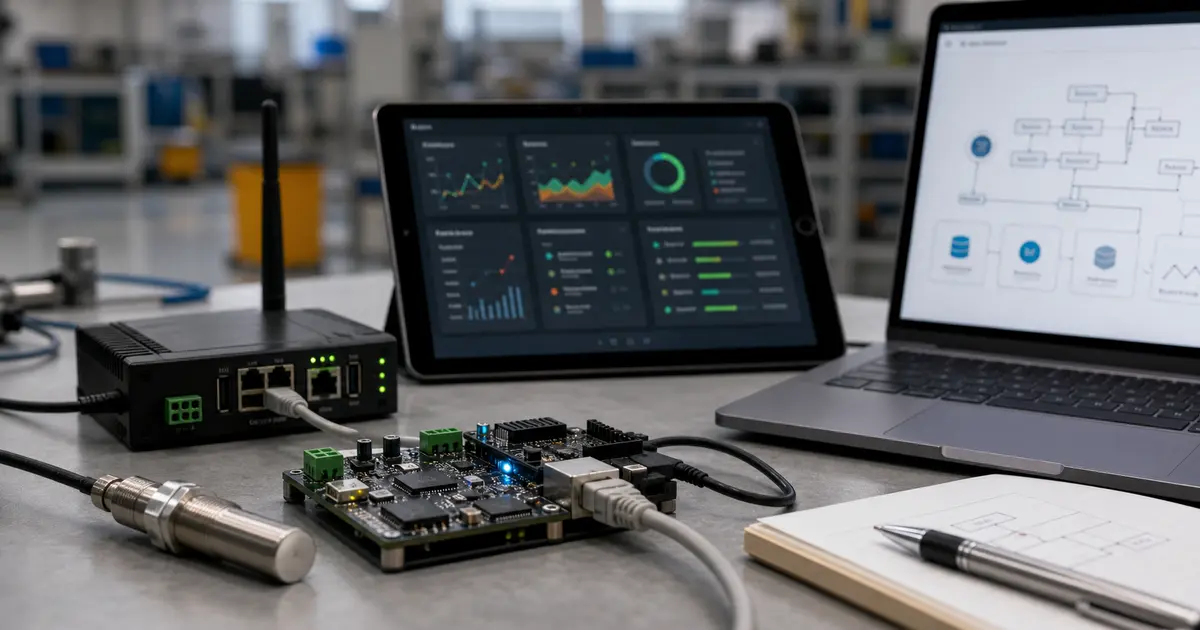
Connecting a PLC, sensor, gateway, scanner, or industrial device is only one part of the project. The more difficult question is what the business wants to do with the signal. A machine status is useful only if the system knows which order, batch, operator, or quality step it belongs to.
That is why production traceability should be designed together with operations, quality, IT, and management. Each group sees a different part of the problem. The software has to connect those views without becoming too complex for daily use.
A safer first scope
- Choose one production line, station, or workflow where traceability has a clear business reason.
- Define the minimum data needed to answer the most important operational questions.
- Connect only the machines or devices that affect those questions.
- Keep manual confirmation where automatic data is not reliable enough yet.
- Create reports that help supervisors act, not just dashboards that display data.
Risks to avoid
The most common risk is collecting too much data without a decision model. The company ends up with dashboards, but operators still use paper or spreadsheets because the system does not match the real workflow.
Another risk is treating hardware integration as a purely technical task. If the production context is missing, the data may be correct but not useful. The system needs a clear relationship between signal, process, responsibility, and decision.
How DG Technologies approaches traceability projects
We start from the operational question, not from the device. What must the company prove, reduce, prevent, or understand? Once that is clear, we map the data sources, integration constraints, user roles, and reporting needs.
A good first release should give the team a reliable view of one important flow. From there, the system can expand to more lines, more controls, more integrations, and more automation.
Common questions
Do all machines need to be connected from the start?
No. It is usually better to start with the machines or stations that explain the most important delays, defects, or compliance risks.
Can manual checks be part of a traceability system?
Yes. Manual confirmations, photos, measurements, and operator notes are often essential, especially when some data cannot be captured automatically yet.
What should a first traceability dashboard show?
It should show information that supports action: order progress, exceptions, quality status, downtime reasons, missing checks, and events that require review.